
Scope 2 emissions are deceptively simple in concept: they represent the greenhouse gases released to generate the electricity, heat, or steam your organisation purchases. In practice, they are one of the most contested and misunderstood areas of corporate emissions reporting.
For most Australian organisations, Scope 2 is also their single largest emissions category. Purchased electricity dominates the carbon footprint of office buildings, retail portfolios, data centres, and manufacturing operations that rely on grid power. Get the Scope 2 number wrong, and the foundation of your entire emissions profile is unreliable.
The complexity lies in how you calculate that number. Australia now recognises two distinct methods for Scope 2 accounting: the location-based method, which reflects the average emissions intensity of the electricity grid, and the market-based method, which reflects the specific energy contracts and renewable energy certificates your organisation holds. Each method answers a different question, serves a different purpose, and produces a different number.
This guide explains both methods in the Australian regulatory context, clarifies when each applies, and outlines what organisations need to do to report accurately under the NGER scheme, the GHG Protocol, and emerging climate disclosure requirements.
What Are Scope 2 Emissions?
The GHG Protocol Corporate Standard defines three scopes of greenhouse gas emissions. Scope 1 covers direct emissions from sources you own or control, such as gas combustion in boilers or fuel use in company vehicles. Scope 3 captures indirect emissions across your value chain, from purchased goods and services to employee commuting. Scope 2 sits between them: the indirect emissions from purchased energy.
In Australia, Scope 2 is overwhelmingly about electricity. The National Electricity Market (NEM) still generates a significant share of its output from coal and gas, which means every kilowatt-hour consumed carries an emissions footprint. For a multi-site organisation with facilities across several states, the Scope 2 calculation involves matching each site's electricity consumption to the correct emission factor, which varies by grid region, reporting year, and calculation method.
Scope 2 is not optional for large Australian emitters. Under the National Greenhouse and Energy Reporting (NGER) scheme, corporations that exceed the facility-level threshold (25,000 tonnes CO₂-e or 100 terajoules) or the corporate-level threshold (50,000 tonnes CO₂-e or 200 terajoules) must report Scope 2 emissions annually, normally by 31 October. For the 2025–26 reporting year, reports are due by midnight (AEDT) Monday 2 November 2026. And as mandatory climate-related financial disclosures expand under the Australian Sustainability Reporting Standards (ASRS), Scope 2 data will feed directly into annual reports and financial statements, raising the stakes for accuracy.
The Location-Based Method
The location-based method calculates Scope 2 emissions using average emission factors for the electricity grid where consumption occurs. It answers the question: what are the emissions associated with the physical electricity delivered to my sites?
In Australia, the location-based method uses state and territory grid emission factors published annually by the Department of Climate Change, Energy, the Environment and Water (DCCEEW) in the National Greenhouse Accounts (NGA) Factors workbook. These factors reflect the average emissions intensity of each state's electricity generation mix, accounting for fuel types, generator efficiency, and transmission losses.
The calculation is straightforward:
Scope 2 emissions (location-based) = Electricity consumed (kWh) × Grid emission factor (kg CO₂-e/kWh)
For a multi-state organisation, each facility's consumption is multiplied by the relevant state-based emission factor. A warehouse in Victoria, where brown coal still features in the generation mix, will carry a higher per-kilowatt-hour emissions factor than a similar facility in Tasmania, which is predominantly hydro-powered.
When to use the location-based method
The location-based method is the default and mandatory approach for NGER reporting. It is also required under the GHG Protocol Corporate Standard, which mandates that all organisations disclose a location-based Scope 2 figure regardless of whether they also report using the market-based method.
The key advantage of the location-based method is consistency. Every organisation in the same grid region uses the same emission factors, which makes benchmarking possible and prevents double counting at the grid level. It reflects the physical reality of the electricity grid rather than the contractual arrangements of individual buyers.
The limitation is equally clear: the location-based method does not reflect an organisation's investment in renewable energy. If you purchase Large-scale Generation Certificates (LGCs) or sign a Power Purchase Agreement (PPA) for renewable electricity, the location-based number does not change. Your reported emissions remain tied to the grid average, regardless of your procurement decisions.
The Market-Based Method
The market-based method calculates Scope 2 emissions based on the specific electricity products and contractual instruments an organisation has purchased. It answers a different question: what are the emissions associated with the electricity I have chosen to buy?
Instead of using average grid emission factors, the market-based method uses emission factors derived from:
- Renewable energy certificates, such as Large-scale Generation Certificates (LGCs) under Australia's Renewable Energy Target, which carry a zero-emission factor when surrendered
- Power Purchase Agreements (PPAs) with specific generators, using the generator's emission factor
- GreenPower products, which are backed by surrendered LGCs and represent certified renewable electricity
- Residual mix factors, applied to any electricity consumption not covered by a contractual instrument
The market-based method rewards organisations that actively procure renewable energy. If your organisation surrenders enough LGCs to cover its entire electricity consumption, the market-based Scope 2 figure can be significantly lower than the location-based figure, or even zero for electricity.
Market-based method under NGER
The Clean Energy Regulator introduced a voluntary market-based method for NGER reporting, first available for the 2024-25 reporting year. Organisations can now report market-based Scope 2 emissions alongside the mandatory location-based figure.
From the 2025-26 reporting year (reports due by midnight (AEDT) Monday 2 November 2026), a critical new rule applies: corporations that elect the market-based method must apply it consistently across all facilities within their corporate group. Cherry-picking the method by facility is no longer permitted. This means organisations need a comprehensive view of their renewable energy certificate portfolio and PPA coverage across every site before committing to dual reporting.
The permitted contractual instruments for NGER market-based reporting include surrendered LGCs, surrendered Small-scale Technology Certificates (STCs), GreenPower products, and eligible PPAs. The Clean Energy Regulator has published detailed guidance on the qualifying criteria for each instrument type.
Location-Based vs Market-Based: A Practical Comparison
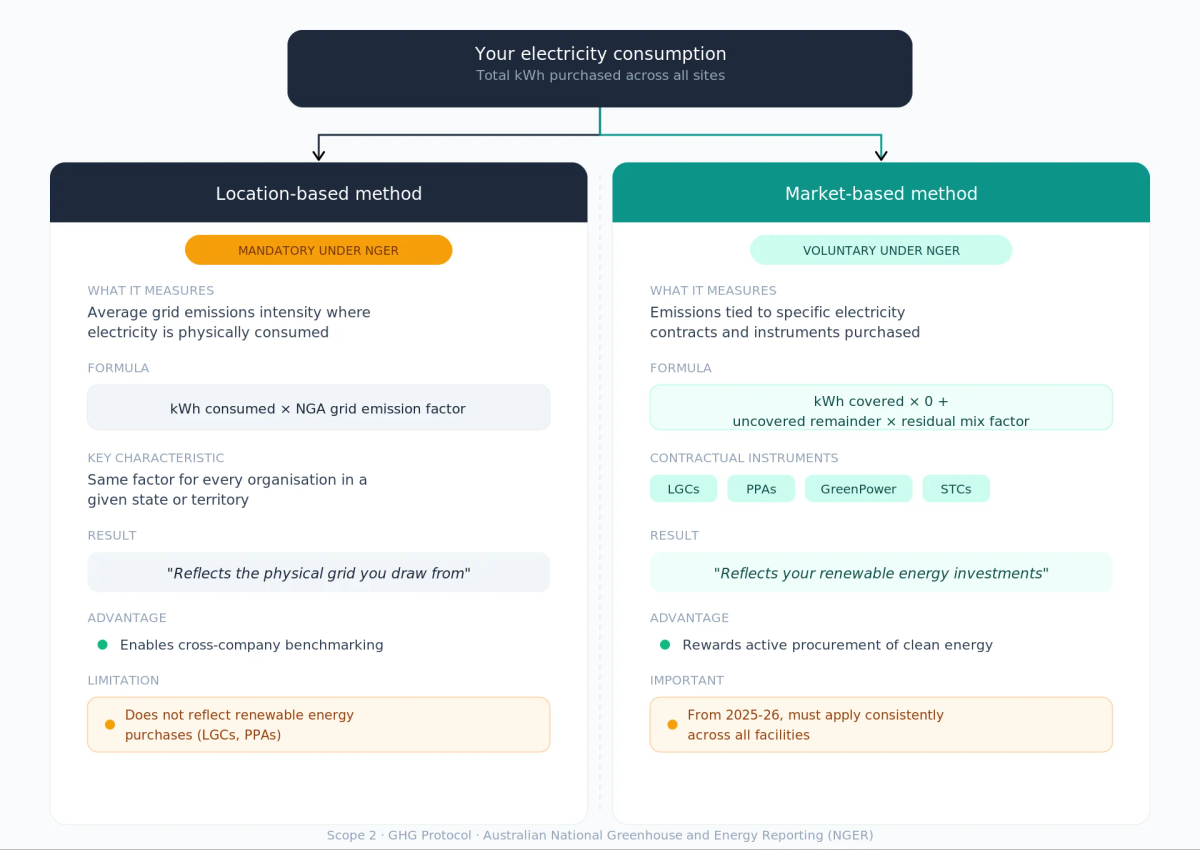
To illustrate the difference, consider a multi-site Australian organisation with facilities across New South Wales, Victoria, and Queensland, consuming a combined 50,000 MWh of electricity annually.
Location-based calculation: Each state's consumption is multiplied by the respective NGA grid emission factor. Using the 2025 factors, the total Scope 2 figure reflects the blended grid emissions intensity across the three states, resulting in a figure driven by the coal and gas share of each state's generation mix.
Market-based calculation: The same organisation has surrendered 20,000 LGCs (covering 40% of its consumption) and signed a PPA with a wind farm in Victoria covering another 15,000 MWh. The remaining 15,000 MWh has no contractual instrument and uses a residual mix factor. The market-based Scope 2 figure is substantially lower because 70% of consumption is backed by zero-emission instruments.
Both numbers are correct. They simply answer different questions. The GHG Protocol explicitly states that the two methods are not intended to be compared or ranked, as each provides important but distinct information.
Why both numbers matter
The location-based method reflects the physical emissions impact of your electricity consumption on the grid. It demonstrates the need for grid decarbonisation and shows where consumption reduction has the greatest climate impact.
The market-based method reflects your procurement decisions and investment in renewable energy. It signals demand for clean energy, supports the business case for PPAs and certificate purchases, and incentivises organisations to actively shift their energy supply.
For this reason, the GHG Protocol requires dual reporting: disclose both figures, explain the difference, and let stakeholders interpret each in context.
NEM Emission Factors: What You Need to Know
The National Electricity Market (NEM) connects Queensland, New South Wales, the ACT, Victoria, South Australia, and Tasmania. Western Australia (SWIS) and the Northern Territory operate separate grids with their own emission factors.
The NGA Factors workbook, published annually by DCCEEW, provides the official Scope 2 emission factors for each state and territory. These factors are updated to reflect changes in the generation mix, with most states showing a 2-3% reduction in grid carbon intensity in the 2025 update as renewables displace coal.
Key trends shaping NEM emission factors include the accelerating retirement of coal-fired generation, with Eraring in NSW scheduled for staged closure and Yallourn in Victoria closing by mid-2028. Rooftop solar penetration continues to grow, reducing daytime grid emissions intensity but creating more volatile intraday emission profiles. Utility-scale wind and solar now contribute a growing share of total generation, while grid-scale battery storage is smoothing renewable intermittency.
For organisations using the location-based method, these trends mean Scope 2 figures will gradually decline even without changes to consumption, simply because the grid is getting cleaner. For organisations considering the market-based method, the declining grid intensity also affects the incremental benefit of purchasing LGCs, as the gap between the grid average and zero narrows over time.
GHG Protocol Scope 2 Revisions: What Is Coming
The GHG Protocol is undertaking a major revision of its Scope 2 Guidance, with a second public consultation expected in 2026 and a final updated standard in 2027. The proposed changes have significant implications for Australian organisations.
The central proposal introduces hourly matching and deliverability requirements for the market-based method. Under the current rules, an organisation can purchase annual LGCs or renewable energy certificates to offset its total annual consumption. The proposed revision would require certificates to be matched on an hourly basis, meaning the renewable generation must correspond to the hour of consumption, not just the annual total.
The deliverability requirement adds a geographic constraint: certificates must come from generators that could plausibly deliver electricity to the consumer's location via a connected grid. This would prevent organisations from purchasing cheap certificates from distant markets that have no physical connection to their consumption.
These changes are not yet finalised, but Australian organisations should be preparing. Hourly matching will require access to interval meter data (typically 30-minute or 5-minute data in the NEM) and granular certificate tracking. Organisations that invest in data infrastructure now will be well positioned when the requirements take effect.
Practicality measures in the proposal include load profiles to approximate hourly data for smaller consumers, exemption thresholds, a legacy clause for existing contracts, and a phased implementation timeline.
Mandatory Climate Disclosures and Scope 2
Scope 2 reporting does not exist in isolation. The Australian Sustainability Reporting Standards (ASRS), effective for large reporters from FY2025-26, require disclosure of Scope 1 and Scope 2 greenhouse gas emissions in annual financial reports. For Group 1 entities (Australia's largest listed companies and financial institutions), this is already in effect. Group 2 entities, which include many NGER reporters, begin mandatory climate-related disclosures from the first annual reporting period on or after 1 July 2026.
The ASRS framework builds on the ISSB's IFRS S2 standard and aligns closely with the GHG Protocol methodology. This means the same Scope 2 data that underpins your NGER report will be scrutinised by investors, analysts, and auditors in the context of your financial statements.
For organisations that have treated NGER compliance as a back-office regulatory exercise, this represents a fundamental shift. Scope 2 data now has board-level visibility and is subject to the same assurance expectations as financial data. Accuracy, methodology consistency, and auditability are no longer optional.
How Utilified Supports Dual-Method Scope 2 Reporting
Utilified's Utility Management System (UMS) is designed to handle the data complexity that dual-method Scope 2 reporting demands.
UMS automatically collects and validates electricity data from invoices, meter feeds, and retailer portals across every site in your portfolio. Each consumption data point is matched to the correct facility, state, and billing period, creating a single source of truth for your electricity data.
For the location-based method, UMS applies the correct NGA emission factors by state and reporting year, automatically updating when new factors are published. For the market-based method, UMS tracks renewable energy certificate holdings, PPA coverage, and GreenPower allocations against each facility's consumption, calculating the market-based Scope 2 figure from the same underlying dataset.
The result is dual-method Scope 2 reporting from one platform, with a complete audit trail from source invoice to calculated emission. No parallel spreadsheets. No manual factor lookups. No last-minute reconciliation between your location-based and market-based numbers.
For energy consultants managing Scope 2 reporting across multiple client portfolios, UMS scales this capability without adding headcount. One platform, consistent methodology, every client.
Explore Scope 2 reporting features in UMS →
Getting Started with Scope 2 Reporting
Whether your organisation is reporting Scope 2 for the first time under mandatory climate disclosures or looking to add the market-based method to your existing NGER report, the path forward follows the same sequence.
Centralise your electricity data. Before you can calculate accurate Scope 2 emissions, you need reliable, complete consumption data across every site. This is the foundation.
Confirm your emission factors. Use the latest NGA Factors workbook for location-based calculations. For market-based reporting, compile your renewable energy certificate holdings, PPA details, and GreenPower contracts.
Choose your reporting approach. If you elect the market-based method under NGER, remember that from 2025-26 it must be applied consistently across all facilities in your corporate group.
Build for auditability. Every data point, emission factor, and certificate surrender should be traceable. Both NGER assurance and ASRS audit requirements demand it.
Automate the ongoing process. Scope 2 is not a once-a-year exercise. With emissions data feeding into financial disclosures, investor reports, and procurement decisions, you need continuous visibility, not an annual scramble.
Utilified brings every utility into one system, validates your data continuously, and provides dual-method Scope 2 outputs your compliance and sustainability teams need.
Book a demo to see Scope 2 reporting in UMS →
Related reading: