
Invoice validation in energy management is the process of systematically checking each line item on a utility bill against contracted rates, published tariffs, and metered consumption data, so that overcharges, billing errors, and rate misapplications can be identified before payment. Industry analysis consistently shows that 3 to 5 percent of commercial energy spend is overpaid because of undetected billing errors [1].
That figure sounds small until you apply it to a real portfolio. An organisation spending $5 million a year on energy across its sites is quietly losing somewhere between $150,000 and $250,000 at that error rate. The cause isn't fraud. Commercial energy bills are simply complex enough that almost nobody checks them line by line.
This guide covers what invoice validation is, why energy bills contain errors in the first place, what an automated process actually checks, how much it can recover, and how validation differs from a one-off bill audit.
Why Do Energy Bills Contain Errors?
Commercial energy bills contain errors because each invoice is assembled from several independent data sources, and any one of those sources can be wrong without affecting the others. Contracted rates, network tariff schedules, meter reads, regulated pass-through costs. A single large-market electricity invoice can carry 15 to 20 separate line items, each calculated under its own set of rules.
In Australia's National Electricity Market (NEM), most errors fall into a few familiar buckets. Tariff misapplication is the costly one: a retailer applies the wrong network tariff code, or the wrong time-of-use bands set by the local Distribution Network Service Provider [2]. Estimated reads are another, where billing is based on a forecast rather than actual consumption. Retailers must use best endeavours to obtain actual reads under the National Energy Retail Rules [3], but in practice estimated billing can persist for months. Meter configuration errors are the most insidious, because an incorrect multiplier or current transformer ratio quietly inflates every bill for that meter until someone catches it. Phantom charges on decommissioned sites and outdated pass-through cost rates round out the list.
What makes these errors expensive is consistency. A meter multiplier error doesn't appear once. It appears on every invoice for that meter, indefinitely, until something prompts a check.
A Worked Example: How a Single Error Compounds
Consider a national retailer running 50 commercial sites. One of them, a mid-sized distribution centre, was reclassified by its DNSP from a low-voltage to a high-voltage network tariff after a connection upgrade in late 2024. The retailer's billing system missed the reclassification and kept billing on the old tariff code.
That single misapplication inflated the network charges component of the site's invoice by roughly $1,800 a month. Across 18 monthly billing cycles before anyone noticed, the total cost was around $32,400. Nothing about the bills looked anomalous in isolation. The totals were consistent month to month, just consistently wrong, and a manual spot-check would have had no reason to flag it.
This is the pattern most billing errors follow. Small enough to look unremarkable on any given invoice. Persistent enough to add up. Only catchable when every line item is reconciled against the underlying tariff schedule and meter configuration on every bill. Under the National Energy Retail Rules, the customer was entitled to a refund, but only once someone identified the error [3]. Validation running on every invoice from the moment the network change took effect would have caught it on bill one.
What Does Automated Invoice Validation Check?
A proper validation engine doesn't spot-check a total. It rebuilds the invoice from source data wherever that data exists, and compares the result against what the retailer charged. Anything that doesn't reconcile gets flagged with the evidence already attached.
The preferred path is to rebuild the invoice from source data. Meter readings for the period are multiplied by the applicable tariff. Demand charges come from the recorded peak. Pass-through costs (Large-scale Renewable Energy Target, AEMO market fees, state-based programs like Victorian Energy Upgrades) are calculated at current rates. Network charges follow the DNSP's schedule [2]. Each component is built independently, and the totals are compared, line by line, against the retailer's invoice.
When meter data isn't available for the period (a new connection, a faulty meter, a data feed that hasn't come through), validation falls back to checking the applied tariff. The contracted rate is matched to the invoiced rate, the tariff code to the DNSP's published schedule, time-of-use bands to their effective dates, and pass-through costs to current rates [3]. The fallback can't catch a meter multiplier error or an estimated-read overcharge, since those need source data. It does catch the tariff misapplications and pricing errors that compound over time.
Utilified's validation engine runs 540 checks per meter each year across both paths. The same rules apply to every invoice, and exceptions are surfaced with the evidence already attached, ready for dispute.
The Invoice Validation Process, End to End
The diagram below shows how a single invoice moves through automated validation, from receipt to either payment or dispute. Each check runs against an independent reference source, and any one of them can flag an exception that holds the invoice for review.
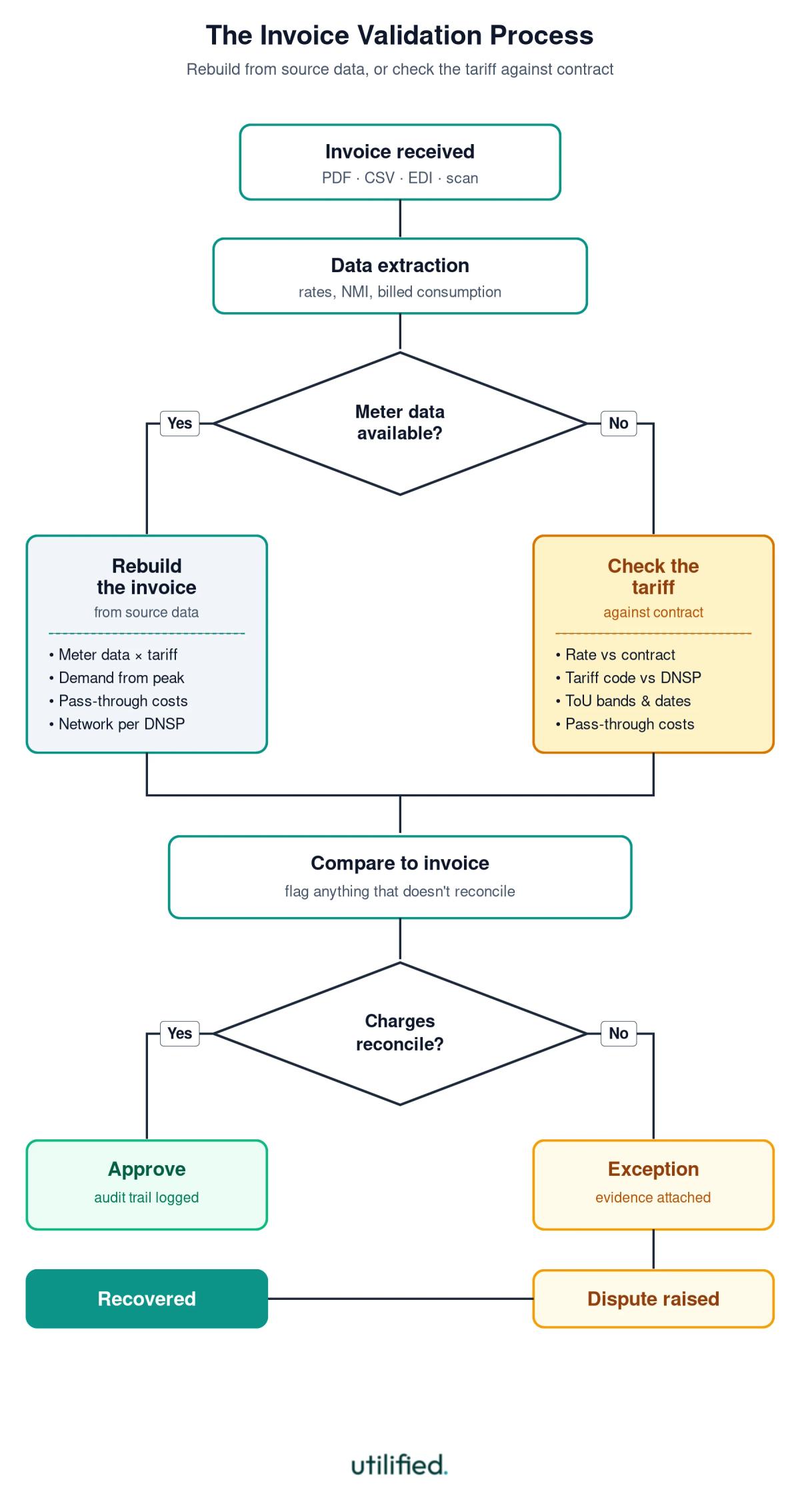
The two paths produce different levels of confidence. A full rebuild catches everything (rate errors, multiplier errors, estimated reads, demand miscalculations), because the engine has independently calculated what the invoice should say. The tariff-check path catches the pricing and tariff errors that account for most of what goes wrong, but it can't surface data-driven errors without meter readings. Either way, the exception comes packaged with the evidence to raise the dispute, and the audit trail on approved invoices is what feeds NGER and ASRS reporting downstream.
How Much Can Invoice Validation Save?
Invoice validation typically recovers 3 to 5 percent of total energy spend by identifying overcharges that would otherwise be paid in full [1]. For a portfolio of 200 sites averaging $50,000 in annual energy spend ($10 million in total expenditure), that works out to $300,000 to $500,000 in recoverable cost every year.
The return isn't only the recovered dollars. Validated invoice data flows into everything downstream: budget forecasting, site-level benchmarking, and emissions reporting under frameworks like Australia's NGER scheme [4] and the ASRS climate disclosure standards. If the consumption figures on your invoices are wrong, your Scope 2 emissions numbers are wrong too. That's a compliance exposure, not just a financial one.
For energy consultants, validation also functions as a service differentiator. Clients expect their consultant to catch billing errors, and delivering that reliably across dozens of client portfolios and thousands of invoices is only possible with a platform doing the underlying work. Billing remains the most common category of energy complaint escalated to ombudsman schemes. EWON alone received 27,588 complaints in 2024–25 [5], which gives an indication of how often errors go undetected until a customer disputes them after the fact.
What Is the Difference Between Invoice Validation and Bill Auditing?
Invoice validation and bill auditing both check utility bills for errors, but they differ in timing and scope. Validation is an ongoing, automated check applied to every invoice before payment. Auditing is a periodic, retrospective review of historical bills, usually conducted as a one-off project to recover past overcharges.
Bill audits have their place. They're useful for unlocking refunds on errors that have already been paid. The problem is that they're retrospective, so the error has already cost you money, and the audit only happens when someone commissions it. The next twelve months of invoices accumulate fresh errors until the next audit comes around.
Validation closes that gap. Because every invoice is checked before payment, errors get flagged while they can still be disputed cheaply, and systematic errors are caught on their first occurrence rather than their fortieth. Validation is the proactive discipline. Auditing is the retrospective cleanup. Organisations serious about controlling utility spend need validation running continuously, with auditing reserved for one-time recovery on historical billing.
How Validation Works in Practice
In a manual process, validation means an analyst opens each PDF, locates the contracted rate, cross-checks the tariff schedule, and reconciles consumption against meter data. Realistically that's 15 to 30 minutes per invoice, assuming the analyst has every reference document to hand. For any portfolio beyond a handful of sites, that doesn't scale, and the subtle errors get missed under time pressure.
A platform approach removes the bottleneck. Utiliread extracts structured data from invoices in any format (PDF, CSV, EDI, or scanned paper) and feeds it directly into the validation engine. Every charge is checked automatically against contracts, tariffs, and interval data. Exceptions are flagged instantly with the evidence attached. The analyst's job shifts from checking every line item to resolving the exceptions that actually matter.
That's what invoice validation looks like when it's built into a utility management platform rather than bolted on. Continuous, automated, auditable, and turning billing risk into recovered revenue without adding headcount.
How Utilified Approaches Invoice Validation
Utilified treats invoice validation as a core function of utility management, not a separate add-on. Utiliread handles data capture, extracting every line item, rate, and metering reference from invoices regardless of format. The UMS validation engine then applies 540 checks per meter each year, reconciling every charge against contracted rates, published network tariffs, and interval meter data.
When the engine finds an exception, Joule (Utilified's AI assistant) surfaces it as a clear, prioritised action with the supporting evidence already assembled, so your team can raise the dispute with the retailer immediately. The result is utility intelligence you can act on. Every invoice validated before payment. Every error documented. Every recovery backed by data.
Explore the Utilified platform →
Frequently Asked Questions
What is invoice validation in energy management?
Invoice validation is the process of systematically checking each line item on a utility bill against contracted rates, published tariffs, and metered consumption data to identify overcharges, billing errors, and rate misapplications before the invoice is paid.
Why do commercial energy bills contain errors?
Commercial energy bills are assembled from several independent data sources, including contracted rates, network tariffs, meter reads, and regulated pass-through costs. Any one of these can be wrong without affecting the others. The most common causes are tariff misapplication, estimated reads, and meter configuration errors.
How much money does invoice validation recover?
Invoice validation typically recovers 3 to 5 percent of total energy spend. For a portfolio with $10 million in annual energy expenditure, that represents $300,000 to $500,000 in recoverable overcharges each year.
What is the difference between invoice validation and bill auditing?
Invoice validation is an ongoing, automated check applied to every invoice before payment. Bill auditing is a periodic, retrospective review of historical bills to recover overcharges already paid. Validation is proactive. Auditing is retrospective cleanup.
Related reading:
- How to Validate Commercial Energy Invoices in Australia: A Complete Guide
- What Is Utility Management Software? A Complete Guide
- Utility Management Software vs Spreadsheets: Why Growing Portfolios Need a Platform
- NGER Reporting Software: How to Automate Your Emissions and Energy Compliance
- Scope 2 Emissions Reporting in Australia: Location-Based vs Market-Based Methods Explained
References
[1] Smarter Business, Business Energy Invoice Validation Explained. Industry analysis indicates commercial energy billing errors typically account for 3–5% of total billed amounts. smarterbusiness.co.uk
[2] Australian Energy Regulator (AER), Regulatory Explainer: Network Tariff Trials. DNSPs set network tariffs in accordance with the National Electricity Rules, with tariff structures reviewed and updated periodically. energyinnovationtoolkit.gov.au
[3] Australian Energy Market Commission (AEMC), National Energy Retail Rules. Retailers must comply with billing, overcharging, undercharging, and dispute resolution requirements under the NERR, including a requirement to use best endeavours to obtain actual reads. aemc.gov.au
[4] Clean Energy Regulator, National Greenhouse and Energy Reporting (NGER). Organisations meeting reporting thresholds must report energy consumption and greenhouse gas emissions under the NGER scheme. cleanenergyregulator.gov.au
[5] Energy & Water Ombudsman NSW (EWON), Annual Report 2024–2025. EWON received 27,588 complaints in 2024–25, with billing remaining the most common complaint category. ewon.com.au